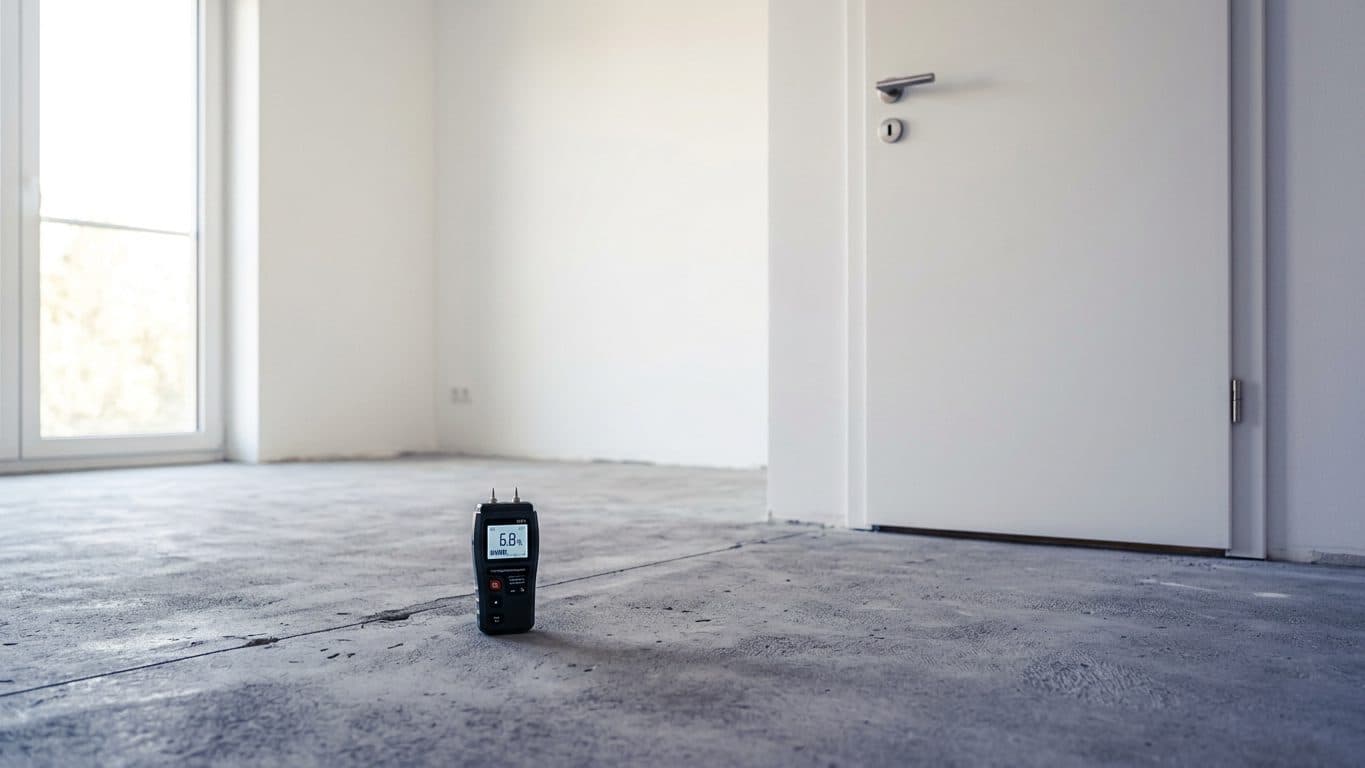
With acceptance under § 640 of the German Civil Code, the burden of proof for defects shifts from the tradesperson to the customer. Whoever has not recorded what they found, agreed and delivered by then stands without evidence in a warranty dispute.
In a warranty dispute, the party that is right rarely wins. The party that can prove it wins. And when the trade business has to prove and when the customer does depends on a single event: acceptance.
What acceptance does legally
§ 640 (1) sentence 1 of the German Civil Code (BGB) obliges the customer to accept the work produced in accordance with the contract unless acceptance is excluded by the nature of the work (unofficial translation). Until acceptance, the contractor must show and prove that the work is free of defects. After acceptance, the customer must prove that a defect exists and that it was already present at acceptance. This reversal of the burden of proof is the most important practical effect of acceptance.
What counts as a defect is defined in § 633 (2) BGB: the work is free of material defects if it has the agreed quality; absent an agreement, if it is suitable for the use presupposed by the contract or otherwise the customary use, and has a quality that is customary for works of the same kind (unofficial translation). The customer's rights in case of a defect are listed in § 634 BGB: subsequent performance, self-remedy, withdrawal or price reduction, and damages.
Acceptance reverses the burden of proof. What you have not documented by then cannot be made up afterwards.
Acceptance need not be formal
§ 640 (2) sentence 1 BGB provides for deemed acceptance: the work is also deemed accepted if the contractor has set the customer a reasonable deadline for acceptance after completion and the customer has not refused acceptance within that period stating at least one defect (unofficial translation). Towards consumers, § 640 (2) sentence 2 BGB makes this conditional on the contractor having pointed out the consequences of a refused or undeclared acceptance together with the request, and that notice must be in text form. This notice, too, needs to be documented, with date and recipient.
And § 640 (3) BGB protects the business: if the customer accepts a defective work although aware of the defect, the customer retains the rights under § 634 nos. 1 to 3 BGB only if they reserve those rights at acceptance (unofficial translation). An acceptance record that lists the known scratch and no reservation is therefore worth more than any later recollection.
How long the customer has
Under § 634a (1) no. 2 BGB, defect claims for a building become time-barred after five years, under no. 1 after two years for other works; under § 634a (2) BGB the period begins with acceptance. In contracts under VOB/B, § 13 (4) no. 1 VOB/B (2016 edition) sets the period for buildings at four years. Five years is a long time to remember what the substrate left behind by another trade looked like.
What actually counts in a dispute
Three kinds of evidence decide warranty cases in practice. First, the condition at the start of work: dated photos of the preceding trade's work, moisture readings, notices of concern. Second, agreements during execution: who ordered the change, when, and whether it was confirmed. Third, acceptance itself: date, participants, defects found, reservations. A photo without date and allocation proves little. An entry that links date, room, finding and photo proves a lot.
One thing to know: the evidential value lies not in an audio recording but in the structured, dated entry. Scrypa deletes the audio file after transcription; what remains is the reviewed, time-stamped entry in the target system.
Record in the moment, not years later
The documentation that counts in a warranty dispute cannot be produced retrospectively. It is created when the fitter stands in front of the damp screed, when the client asks for a change, when the scratch is pointed out at handover. Whoever speaks what they see and what is agreed in those moments has, four or five years later, the evidence that § 640 BGB demands of them. Scrypa Trades turns that speaking into a dated entry in your software.
This article gives a general account of the legal position under the German Civil Code and VOB/B (2016 edition) and is not legal advice for individual cases.
The figures in this article are illustrative and based on industry studies of voice-based documentation. They do not replace an assessment for your own organisation.